Fall of Rome — Four Ancient Roman Coins from the Empire's Final Century
Fall of Rome — Four Ancient Roman Coins from the Empire's Final Century
Couldn't load pickup availability
Fall of Rome — Four Coins from the Late Fourth-Century Roman Empire
Own Coins from a Generation of Transformation
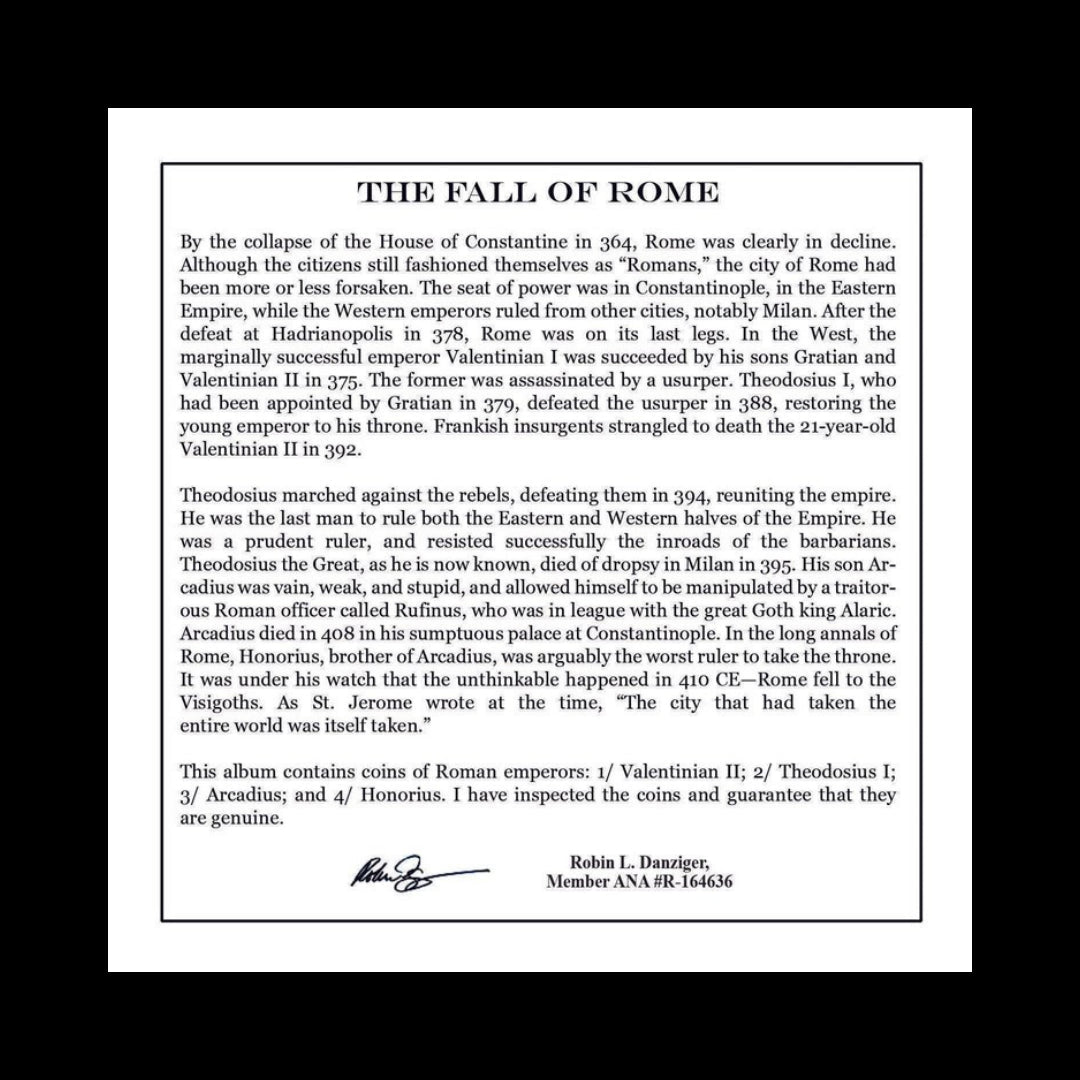
A collection of four authentic Roman bronze coins of Valens, Gratian, Valentinian II, and Theodosius I—rulers from the late fourth century, when Gothic migration and warfare, civil conflict, religious change, and increasingly separate eastern and western courts reshaped the Roman world.
✓ Four Authentic Roman Coins
✓ Guaranteed Authentic
✓ 30-Day Returns
📷 Coins shown are representative examples. You will receive one authentic bronze coin of each listed emperor. Individual coins will vary in portrait, reverse design, strike, preservation, mint, and overall appearance.
Why This Collection Matters
The later fourth century was not simply the moment when Rome suddenly “fell.” It was a period of major transformation within an empire that remained powerful but faced serious military, political, and religious challenges.
Valens was killed at the Battle of Adrianople in AD 378 during Rome’s conflict with Gothic forces. The defeat was a major military disaster, though it did not by itself make the later collapse of western imperial government inevitable.
Gratian ruled in the West and elevated Theodosius I as eastern Augustus after Adrianople. His reign also belonged to a period in which Christian emperors increasingly withdrew state support from traditional Roman religious institutions.
Valentinian II became emperor as a child. His reign illustrates the importance of court factions, powerful generals, bishops, and competing imperial governments in late Roman politics.
Theodosius I became the last emperor to exercise authority over both eastern and western imperial territories before his death in AD 395. Under his government, Nicene Christianity received increasingly strong imperial backing and traditional public cults faced growing legal restrictions.
After Theodosius died, his sons Arcadius and Honorius ruled the eastern and western courts separately. This division proved durable, but it should not be described as a formal moment when Theodosius permanently split one Roman Empire into two legally unrelated states. Romans continued to understand the eastern and western governments as parts of the Roman imperial order.
Western imperial government eventually ended in AD 476, while the Roman Empire centered on Constantinople survived for centuries. Modern historians conventionally call that continuation the Byzantine Empire, although its inhabitants continued to identify themselves as Romans.
These four coins therefore preserve a generation of profound change—not four “last western emperors,” but four rulers from the decades that helped shape the later Roman and medieval worlds.
What You’ll Receive
- One authentic bronze coin of Valens
- One authentic bronze coin of Gratian
- One authentic bronze coin of Valentinian II
- One authentic bronze coin of Theodosius I
- Civilization: Roman Empire
- Period: Late 4th century AD
- Material: Bronze
- Presented in a mini album
- Representative examples shown (each coin is unique)
Buy with Confidence
- Guaranteed authentic ancient coins
- Carefully sourced and attributed
- 30-day return policy
- Secure shipping from the U.S.
Learn More

Continue the story in the Kinzer Coins Journal: The Coins That Witnessed the Fall of Rome.