

Constantine the Great Coins: Why He’s a Great First Roman Emperor
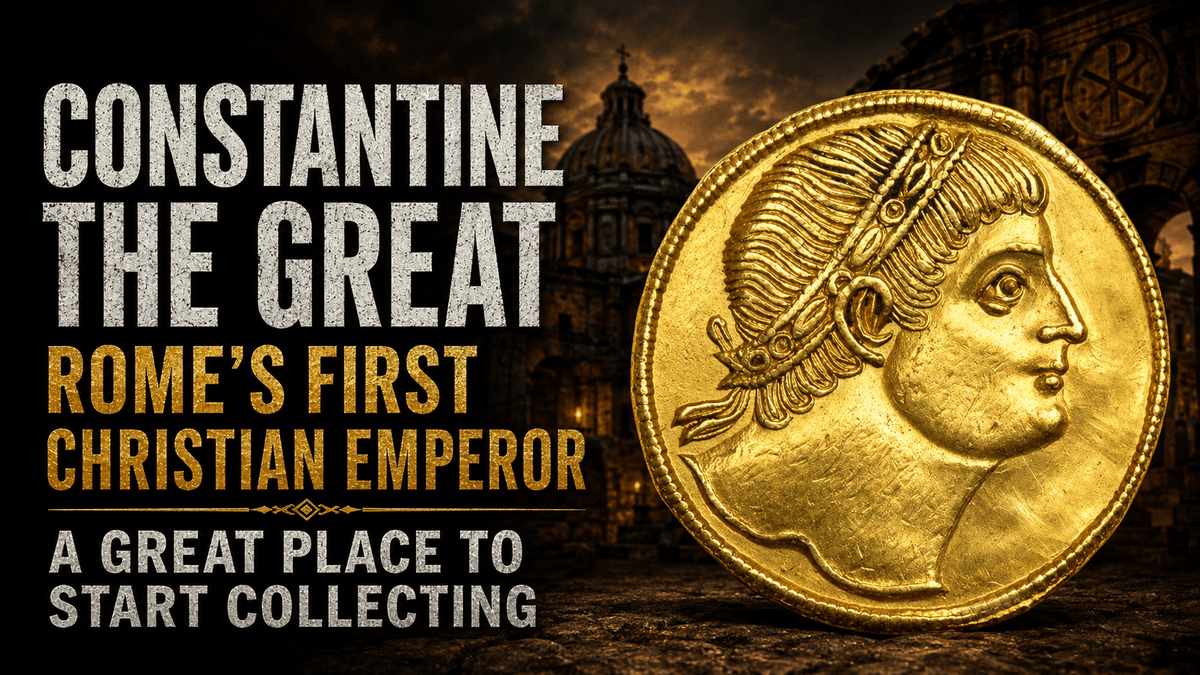
Constantine the Great Coins: Why He's a Great First Roman Emperor
Famous history, huge surviving coinage, and affordable common bronzes, the ideal first coin.
Constantine the Great is one of the best Roman emperors for a new ancient-coin collector.
His coins are historically important, widely available, varied enough to teach attribution, and often obtainable without a large financial commitment.
Who Was Constantine the Great?
Constantine I ruled from AD 306 to 337. He emerged from the Tetrarchic civil wars, defeated Maxentius at the Battle of the Milvian Bridge in AD 312, and became sole ruler after defeating Licinius in AD 324. His reign reshaped Roman politics, religion, imperial administration, and the empire's geographic center of gravity.
Constantine did not single-handedly legalize Christianity, Galerius had already issued an edict of toleration in AD 311 ending the Great Persecution in much of the empire. In AD 313, Constantine and Licinius agreed on the policy conventionally called the Edict of Milan, which established broad religious toleration and ordered restoration of confiscated Christian property. Constantine subsequently gave Christianity increasing imperial support, though the empire did not become officially Christian overnight and traditional religious practices continued. He also transformed the old Greek city of Byzantium into a new imperial capital, Constantinople, formally dedicated in AD 330, which remained an imperial capital for more than a thousand years.

Why Are Constantine Coins Good for Beginners?
Constantine and his family ruled during a period of enormous coin production, so genuine Late Roman bronzes of the Constantinian era survive in large numbers. That availability lets a beginner learn portraits, legends, reverse types, mint marks, officina marks, flan shape, strike, centering, and patina without starting with an expensive rarity.
- Sol and SOLI INVICTO COMITI, the unconquered sun god
- Military standards and soldiers, and camp gates
- Victory and votive inscriptions
- VRBS ROMA commemoratives with the she-wolf and twins
- CONSTANTINOPOLIS commemoratives with Victory on a prow
Not every commemorative in this broader Constantinian-era group carries Constantine's portrait, which is another useful lesson in attribution. Some of his coins carry Christian symbols and many do not: Constantine's coinage is particularly valuable because it documents a complicated religious transition rather than an overnight replacement of traditional Roman imagery. Coins pairing Constantine with Sol remained important after AD 312, while Christian signs including forms of the Chi-Rho appear on particular issues and became more prominent later. Do not identify every cross-like mark as Christian without checking the exact type and reference.
How Do You Identify a Constantine Coin?
Use several features together, and always read the legend rather than relying only on the portrait, Constantine I, Constantine II, Constantius II, Constans, and other family members can look confusing at first.
- Obverse legend, confirms which Constantine or family member is named
- Portrait, useful but not sufficient by itself
- Reverse legend and type, often narrows the issue significantly
- Mint mark, can identify Trier, Rome, Constantinople, Nicomedia, Antioch, and others
- Officina mark, identifies a workshop within the mint on many issues
- Weight and diameter, useful supporting evidence
For a first coin, prioritize a genuine coin with a recognizable portrait, enough legend to identify the ruler, a clear reverse, and preferably a visible mint mark. Perfect centering and complete legends are desirable but not required, historical clarity and natural surfaces are usually more useful than rarity. There is no single price for a Constantine coin: common Late Roman bronzes can be inexpensive, while scarce mints, rare busts, important reverse types, medallions, silver, gold, and exceptional high-grade bronzes can cost much more.
Turn One Constantine Coin Into a Collection
After your first coin, several collecting paths open: Constantine by mint, by reverse type, or before and after AD 324; Constantinian family members such as Helena, Fausta, Crispus, Constantine II, Constantius II, Constans, and Delmatius; city commemoratives for Rome and Constantinople; or religious imagery from Sol to Christian symbols. This is one reason Constantine works so well as a first emperor: a beginner coin can naturally grow into a serious specialist collection. One of his most famous and distinctive portrait types shows the emperor gazing upward, the "Eyes to Heaven" style tied to his religious self-presentation, a natural next step once your first common bronze is in hand.

Constantine gives a new collector almost everything that makes ancient coins compelling: a famous ruler, civil war, a new imperial capital, changing religious imagery, dozens of mints and reverse types, and enough surviving material to make the field approachable.
Hold what the greats held.
Frequently Asked Questions
Are Constantine the Great coins rare?
Many bronze issues are common because they were struck in large quantities, although particular mints, reverse types, busts, denominations, and varieties can be scarce or rare.
Did Constantine put the Chi-Rho on all his coins?
No. Christian symbols occur on particular issues, while traditional Roman imagery continued throughout much of his reign.
What is the easiest Constantine coin to collect?
Common Late Roman bronze issues with clear legends and mint marks are usually the easiest entry point.
Is every coin that says CONSTANTINOPOLIS a portrait coin of Constantine?
No. The famous CONSTANTINOPOLIS commemorative shows a personification of Constantinople rather than Constantine himself.
Why collect Constantine instead of another emperor?
He combines major historical importance, extensive surviving coinage, many mints and designs, and affordable common types, an unusually strong combination for a beginner.
History wasn't just written. It was minted.
Book II Value Guide
Compare late Roman coin values from Diocletian through Julian II
Browse Constantine the Great Coins at Kinzer Coins
Authentic bronzes of the first Christian emperor, the ideal first ancient coin, NGC-certified where available, every coin backed by our lifetime authenticity guarantee.
Browse Beginner Coins