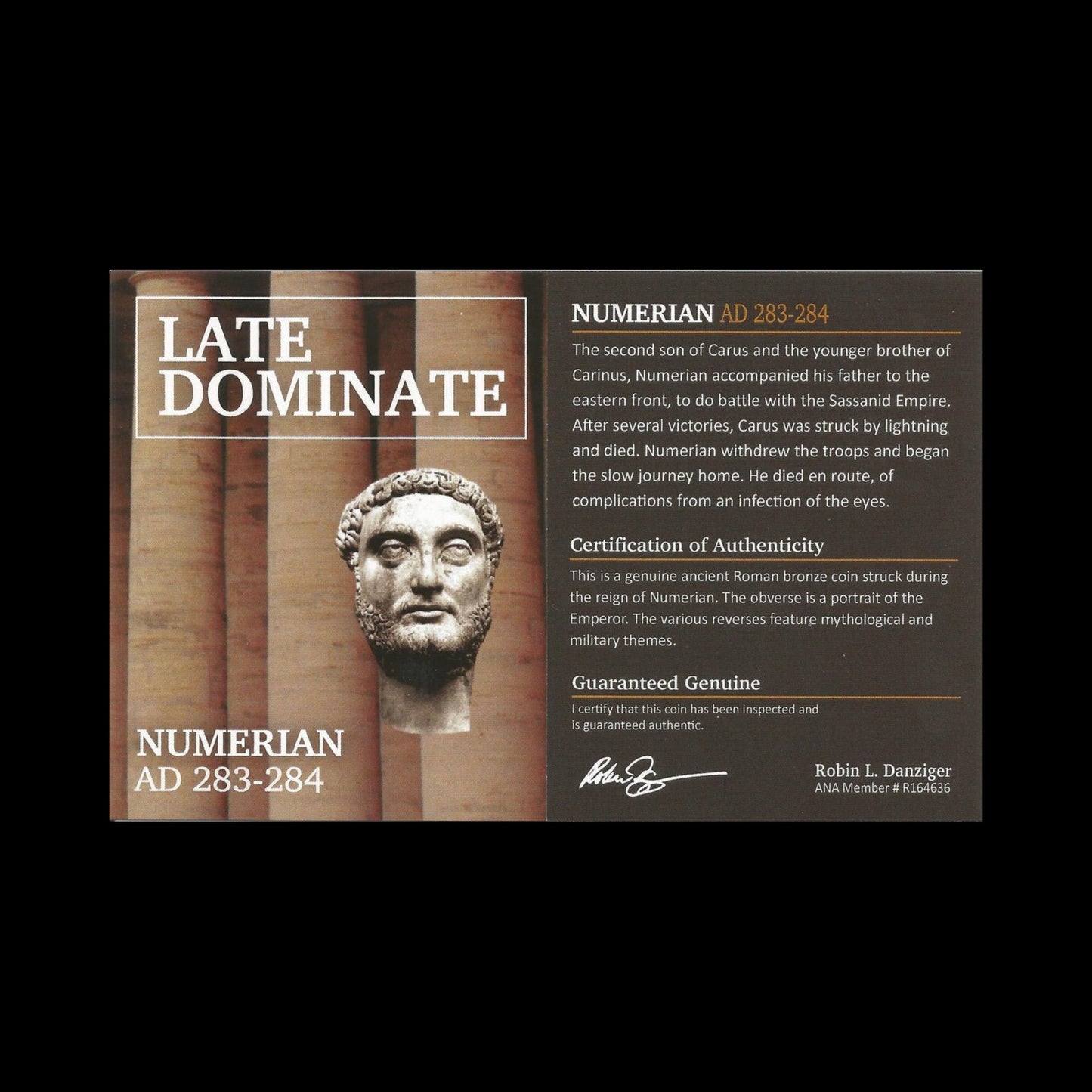
Numerian Ancient Roman Antoninianus — Mysterious Death Before Diocletian (AD 283–284) — NGC Certified
Numerian Ancient Roman Antoninianus — Mysterious Death Before Diocletian (AD 283–284) — NGC Certified
Couldn't load pickup availability
Numerian Antoninianus - The Emperor Whose Mysterious Death Opened the Door to Diocletian
Own a Bronze Coin from the Emperor Found Dead in His Litter - His Death Opened the Door to Diocletian
Explore an NGC-certified Numerian bronze antoninianus, AD 283–284. Representative examples vary.
✓ NGC Certified
✓ Guaranteed Authentic
✓ 30-Day Returns
📷 Coin shown is a representative example. You will receive one authentic NGC-certified bronze antoninianus of Numerian. Each coin is unique and will vary in grade, strike, centering, preservation, remaining silver wash, and individual appearance.
💀 Issued during the one-year reign of the emperor whose mysterious death became one of the greatest unsolved events in Roman history
⚔️ Features the radiate portrait of Numerian alongside reverses honoring Jupiter, Mars, Victory, and the military virtues expected of a Roman emperor
🤲 An NGC-certified bronze antoninianus from the dramatic transition that ended the Crisis of the Third Century and began the age of Diocletian
Own This Piece of History
Why This Coin Matters
Few Roman emperors left behind a mystery as enduring as Numerian.
The younger son of Emperor Carus, Numerian was elevated to Caesar alongside his older brother Carinus before becoming Augustus during his father's successful campaign against the Sasanian Persian Empire. In AD 283, Carus unexpectedly died while deep in Persian territory. Ancient writers famously claimed lightning struck the imperial tent, though the true cause remains unknown. The eastern army immediately began its long retreat west under Numerian's authority.
He never completed the journey.
During the retreat, Numerian reportedly developed a painful eye illness that required him to travel inside a closed litter. His father-in-law and Praetorian Prefect, Aper, informed the army that the emperor was too ill to appear in public and ordered the curtains kept shut while the march continued.
Days passed.
Eventually, soldiers accompanying the imperial procession noticed the unmistakable smell of decomposition. When the litter was finally opened, Numerian was discovered dead, his body already badly decayed. Whether he had died from illness, been secretly murdered, or succumbed to some other cause remains one of the great unsolved mysteries of Roman history.
What happened next transformed the empire.
The eastern army assembled to choose a new emperor. Before the gathered soldiers, the commander of the imperial bodyguard, Diocles, publicly accused Aper of murdering Numerian. Drawing his sword, he personally killed the Praetorian Prefect in front of the assembled army. The dramatic act immediately established Diocles - soon known to history as Diocletian - as the avenger of the fallen emperor, and the army proclaimed him Augustus.
Whether Aper was actually guilty has never been proven. Ancient historians disagree, and modern scholars continue to debate whether Numerian died of natural causes, was murdered by Aper, or whether Diocletian himself simply seized a political opportunity. Whatever the truth, Numerian's death became the turning point that ended one dynasty and began another.
Diocletian would go on to defeat Carinus, become sole ruler, and launch the most sweeping reforms since Augustus. He reorganized the provinces, restructured the army, introduced the Tetrarchy, overhauled taxation, and attempted to stabilize Rome's collapsing currency. The empire that survived the Third Century Crisis was largely the empire Diocletian created - and that transformation began with the mysterious death of Numerian.
This authentic bronze antoninianus, often still preserving traces of its original silver wash, circulated during Numerian's final year as emperor. It represents the last chapter of one dynasty and the first step toward Rome's remarkable recovery.
More than an ancient coin, it is a tangible connection to one of the greatest mysteries - and one of the most consequential successions - in Roman history.
Perfect For
- Collectors of Crisis of the Third Century coinage
- Students of Roman imperial history
- Enthusiasts of Diocletian and the Tetrarchy
- NGC-certified ancient coin collectors
- Anyone looking for a historically fascinating and unique gift
What You'll Receive
- One authentic Roman bronze antoninianus of Numerian
- Civilization: Roman Empire
- Ruler: Numerian (AD 283–284)
- Denomination: Bronze Antoninianus (originally issued with a thin silver wash, often partially preserved)
- NGC certified for authenticity and preservation
- Presented in an NGC holder
- Representative example of the type (each coin is unique)
Continue the Story
Numerian's mysterious death marked the end of the Crisis of the Third Century's final imperial dynasty and cleared the way for Diocletian's rise. Through military reform, administrative reorganization, and the creation of the Tetrarchy, Diocletian rebuilt an empire that had stood on the brink of collapse.
Explore our other Roman, Byzantine, Biblical, Greek, medieval, and world coin collections to continue your journey through the rulers, civilizations, and events that changed history.
Buy with Confidence
- NGC certified for authenticity and preservation
- Carefully sourced and verified
- 30-day return policy
- Secure shipping from the U.S.
New to Ancient Coins?
Start your journey here:
Start here: beginner-friendly ancient coins
Learn More

Continue the story in the Kinzer Coins Journal: Numerian Coins: The Emperor Found Dead on the Road from Persia.