

Numerian Coins: The Emperor Found Dead on the Road from Persia
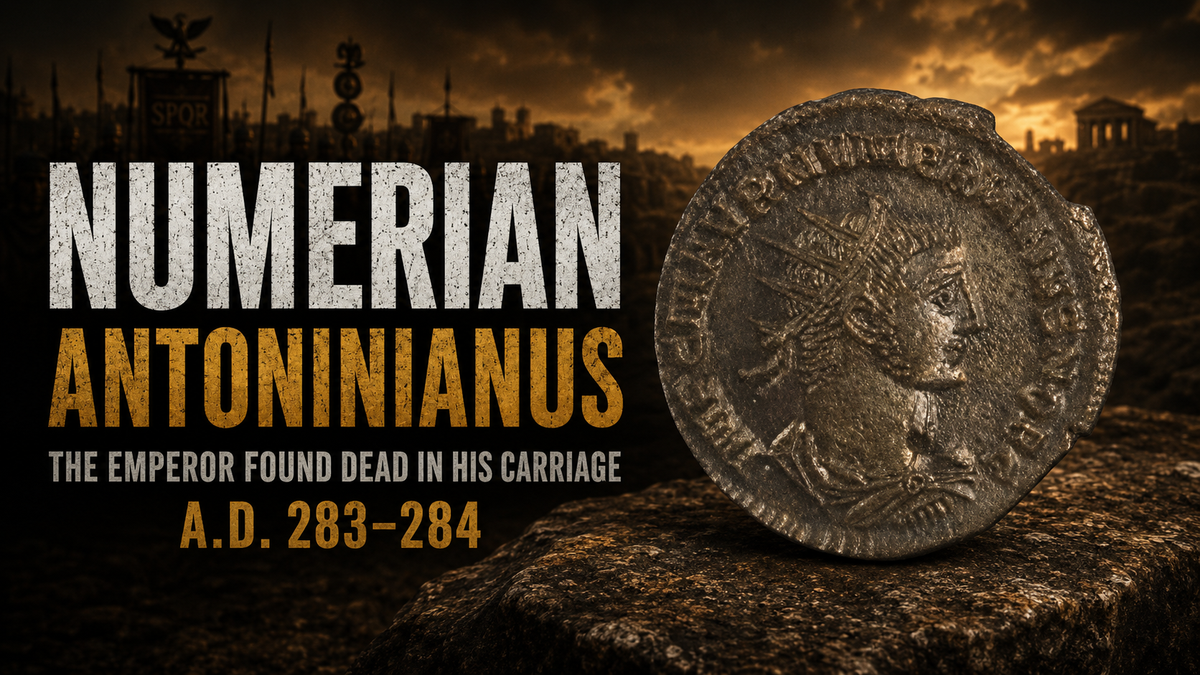
Collecting the Coins of Numerian
AD 283 to 284, son of Carus, the emperor found dead in his carriage.
Numerian is remembered not for great conquests, but for one of the strangest imperial deaths in Roman history, and for the coins that traveled with his army across Persia before the mystery unfolded.
The younger son of Emperor Carus and brother of Carinus, Numerian accompanied his father on a highly successful eastern campaign against the Sasanian Empire. When Carus died suddenly in AD 283, killed by lightning, or so the story went, Numerian became Augustus and began leading the Roman army back west.
Ancient sources describe him as unusually educated and literary for an emperor of the military-dominated 3rd century. He never made it home intact. His coins are artifacts from one of Rome's greatest unsolved imperial mysteries, struck during the final years of the Crisis of the Third Century just before Diocletian transformed the empire forever.
The Emperor in the Sealed Carriage
During the long march westward from Persia, Numerian reportedly developed a painful eye condition and began traveling in a closed imperial carriage. For days, soldiers saw nothing of their emperor. When the carriage was finally opened, Numerian was discovered dead inside.
Suspicion fell immediately on his father-in-law and praetorian prefect, Aper. The officer Diocles, the future Emperor Diocletian, accused Aper of murdering Numerian before the assembled army and personally executed him on the spot. Within days, Diocletian was proclaimed emperor by the eastern legions. Whether Aper truly murdered Numerian, or whether Diocletian used the moment to seize power after a natural death, remains one of Rome's most debated imperial questions. What is certain is that Numerian's death ended the Caran dynasty and opened the path for one of the most consequential reigns in Roman history.
Numerian's coins traveled with Roman armies across Persia during one of the empire's final great crises, struck just before the world changed, held by soldiers who would soon proclaim a new emperor over their dead one.

The Coinage of Numerian
The primary denomination of Numerian is the silvered billon antoninianus, the radiate coinage that dominated late Crisis-era Roman commerce. By his reign the antoninianus had become heavily debased, with only a thin silver wash applied to the surface, but many surviving examples still retain traces of their original silvering. Portraits show a radiate crown, military cuirass, and the stern youthful features of the late 3rd century style.
- Virtvs Avgg, the emperor standing with spear and globe, the most common and desirable type, the plural AVGG confirming joint imperial rule with his brother Carinus
- Victoria Avgg, Victory advancing with wreath and palm, celebrating the Persian campaign, struck while the army was still in the east, the most directly campaign-connected type
- Pax Avgvsti, Pax standing with olive branch and scepter, peace imagery projected during the withdrawal from Persia, a slightly scarcer type with strong visual appeal
- Mars Victor and Sol, Mars the Victor and Sol Invictus types, military and solar divine symbolism common across the Crisis era, popular for thematic late Roman and Caran dynasty sets
Mints of Numerian
Numerian's coins were struck across both eastern and western imperial mints during his brief reign, eastern issues reflecting the Persian campaign, western issues struck as the army made its long return march toward Rome.
- Eastern mints, Cyzicus, Antioch, Tripolis, and Alexandria, reflecting the Persian campaign and the army's presence in the east
- Western mints, Rome, Ticinum, Siscia, and Lugdunum, struck as the imperial army marched its long road home
Why Collect Numerian
Start here. A VIRTVS AVGG silvered antoninianus, the most available Numerian type, still retaining traces of original silvering on well-preserved examples. Strong radiate portrait, legible legends, and direct connection to the Persian campaign.
Go deeper. Build a complete Caran dynasty set pairing Numerian with Carus and Carinus, one of the most historically cohesive short-dynasty collecting goals in the Crisis of the Third Century, bookended by Diocletian's rise on one side and Probus on the other.

Numerian's coins are affordable, historically extraordinary, and connected to one of Rome's most dramatic stories: a poet-emperor who marched across Persia, developed a mysterious illness, and was found dead in a sealed carriage while his army marched home without him. The man who accused his murderer became Diocletian, the emperor who rebuilt Rome from the ground up. Every Numerian antoninianus existed at the exact hinge point between the Crisis of the Third Century and the late Roman world that followed. Few coins at this price point carry that much history in their metal.
Hold what the greats held.
Browse Caran Dynasty Coins at Kinzer Coins
Authentic silvered antoniniani from the final years of the Crisis of the Third Century, NGC-certified where available, guaranteed authentic, with 30-day returns.
Browse Roman Coins