

Titus Coins: Judaea Capta, Colosseum & Flavian Collector’s Guide
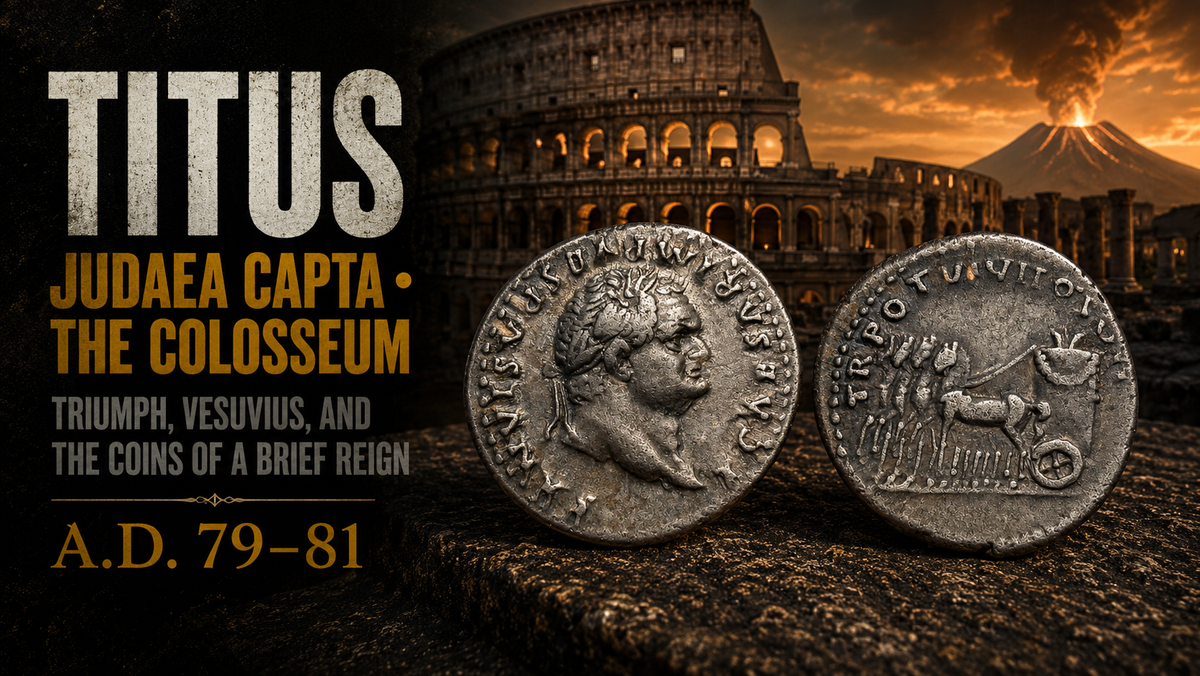
Collecting the Coins of Titus
AD 79 to 81, the conqueror of Jerusalem, the Colosseum, and the disasters of a twenty-six-month reign.
Titus ruled as emperor from AD 79 to 81, but his coinage reaches back through years as Caesar and designated heir under Vespasian.
His coins connect collectors to the Flavian dynasty, the Roman victory in Judaea, the opening of the Flavian Amphitheatre, and one of the shortest event-filled reigns of the early Empire.
In little more than two years on the throne, Titus destroyed Jerusalem's Second Temple as his father's general, inaugurated the Colosseum, and faced the eruption of Vesuvius that buried Pompeii. Few emperors packed as much consequential history into so short a reign.
Who Was Titus?
Titus was the elder son of Vespasian. During the First Jewish Revolt he served with his father and, after Vespasian was proclaimed emperor in AD 69, took over command of the war. Titus captured Jerusalem in AD 70 after a brutal siege in which the Second Temple was destroyed.
The fall of Jerusalem did not immediately end all resistance in Judaea; Roman operations continued against remaining strongholds, with Masada falling later. Titus returned to Rome and became Vespasian's principal heir and colleague before succeeding him peacefully in AD 79.
What Are Titus Judaea Capta Coins?
The broader Judaea Capta series celebrated Flavian victory in the Jewish Revolt. Coins were issued under Vespasian and Titus in multiple metals, denominations, legends, and designs. Some show a mourning personification of Judaea beneath a palm tree; others use captives, trophies, Victory, or related imagery.
Titus has a particularly direct connection to the series because he commanded the siege and capture of Jerusalem. Collectors should nevertheless identify the exact issuer and date: many famous Judaea Capta coins belong to Vespasian's reign even when Titus's military victory provides part of their historical context.
Did Titus Put the Colosseum on a Coin?
Yes. An exceptionally rare sestertius type associated with Titus depicts the Flavian Amphitheatre in remarkable architectural detail. Vespasian began the building; Titus inaugurated it in AD 80, and Domitian later completed additional work.
The coin is one of the great architectural types of Roman numismatics, but descriptions should avoid treating every detail of the opening games as certain. Ancient sources describe elaborate spectacles, yet the often-repeated claim of exactly "100 days" of games is better treated as a traditional approximation than a securely documented figure.

Major Titus Coin Types
Titus struck across silver, bronze, gold, and provincial issues, spanning both his years as Caesar under Vespasian and his brief sole reign.
- Silver denarii, the most practical way to collect Titus, from both his Caesar years and sole reign, with deities, imperial virtues, dynastic themes, and military imagery
- Bronze sestertii, large portraits and detailed reverses, the Colosseum type at the extreme high end while typical sestertii remain far more attainable
- Gold aurei, dynastic, religious, and victory themes, with prices varying enormously by type, condition, style, and provenance
- Alexandrian tetradrachms and provincial coins, local denominations, Greek legends, and regional styles from Alexandria and other eastern mints
Titus, Vesuvius, and the Disasters of AD 79 to 80
Mount Vesuvius erupted in AD 79 during Titus's reign, destroying Pompeii and Herculaneum and devastating the surrounding region. Rome also suffered a major fire in AD 80, and ancient sources report an epidemic during the reign.
Coins should not automatically be assigned to one of these disasters simply because they were struck in AD 79 to 81. The connection is strongest when the reverse type or inscription specifically supports that interpretation.
How to Collect Titus Coins
A portrait denarius is a straightforward starting point. From there, collectors can compare Caesar-period and sole-reign issues, add a provincial tetradrachm, or pursue a Judaea-related type. A three-emperor Flavian set of Vespasian, Titus, and Domitian is also compact and historically coherent, the founder, the conqueror of Jerusalem, and the last of the dynasty, spanning the entire Flavian age in three coins.


Hold what the greats held.
Frequently Asked Questions
When did Titus rule?
He ruled as emperor from AD 79 until his death in AD 81, after years as Caesar and heir under Vespasian.
Did Titus destroy the Temple in Jerusalem?
Titus commanded the Roman forces that captured Jerusalem in AD 70, during which the Second Temple was destroyed. Ancient sources debate aspects of responsibility and intent, so it is safest to state the event rather than claim a securely known personal order to burn the Temple.
Did Titus build the Colosseum?
Vespasian began it, Titus inaugurated it in AD 80, and Domitian completed further work.
Are all Judaea Capta coins Titus coins?
No. The series spans multiple Flavian issues, especially under Vespasian and Titus.
History wasn't just written. It was minted.
Own a Coin of the Emperor Who Opened the Colosseum
Authentic Roman coins, NGC-certified where available, guaranteed authentic, with 30-day returns. Every piece ships with its history already attached.
Browse Roman CoinsContinue the Flavian Dynasty
Read More: Collecting the Coins of Vespasian, Founder of the Flavian Dynasty