Kinzer Coins
Crisis of Empire — Twenty Ancient Roman Bronze Coins (AD 180–400)
Crisis of Empire — Twenty Ancient Roman Bronze Coins (AD 180–400)
Couldn't load pickup availability
Crisis of Empire — Twenty Roman Coins from AD 180–400
Own a Coin Timeline of Rome’s Third-Century Crisis and Recovery
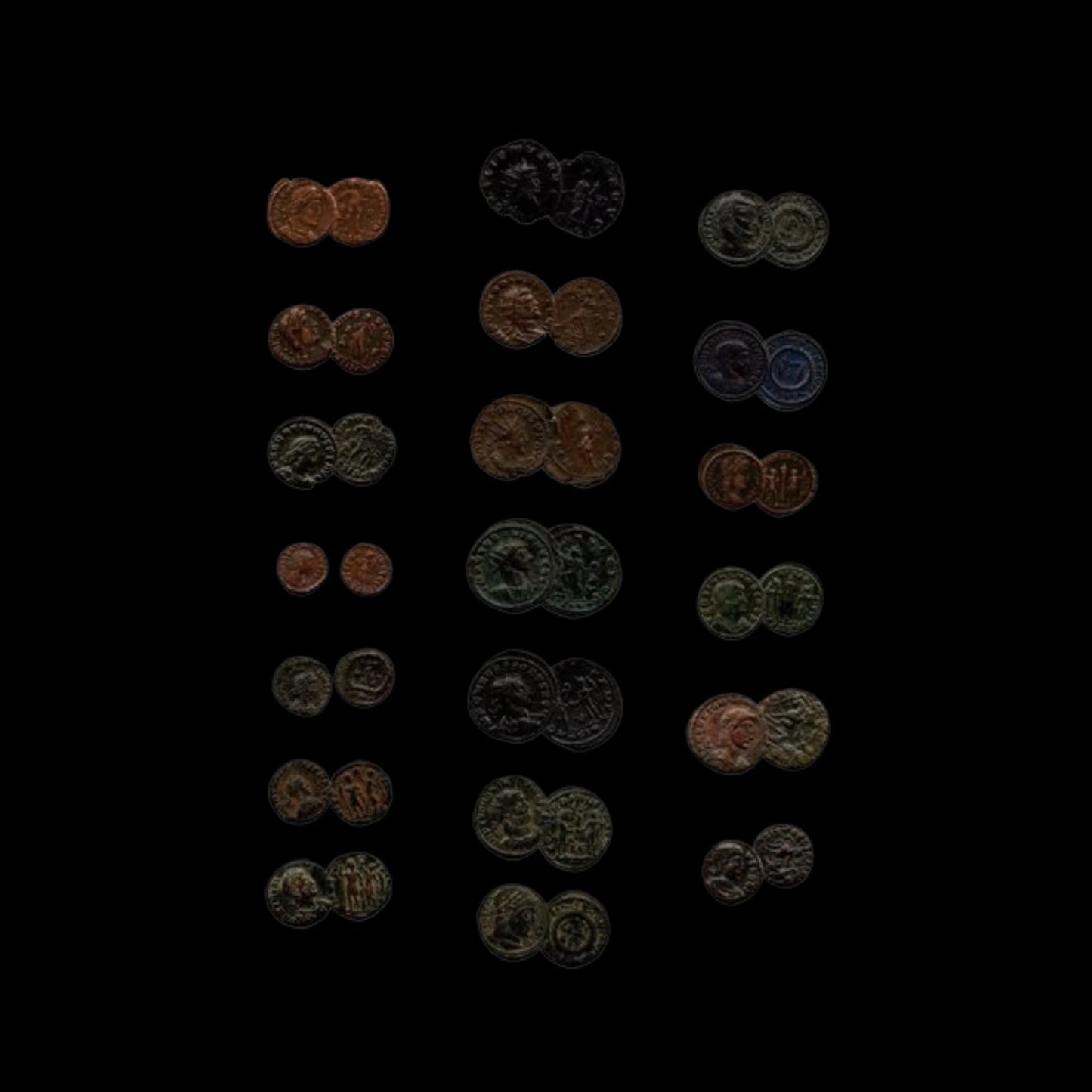
A collection of 20 authentic Roman coins spanning the long era from the later second century through the Crisis of the Third Century, the Tetrarchy, and the Constantinian age.
✓ 20 Authentic Roman Coins
✓ Guaranteed Authentic
✓ 30-Day Returns
📷 Coins shown are representative examples. You will receive twenty authentic Roman coins spanning approximately AD 180–400. Exact rulers, dates, mints, denominations, reverse types, and condition will vary.
⚔ Covers civil war, invasion, breakaway regimes, monetary change, and imperial recovery
👑 Represents the world of the soldier-emperors, Diocletian’s reforms, and Constantine’s dynasty
🤲 Twenty genuine artifacts illustrating more than two centuries of Roman transformation
Why This Collection Matters
The Roman Empire faced an extraordinary concentration of crises during the third century. Emperors were repeatedly overthrown, armies elevated rival candidates, Germanic groups crossed the frontiers, the Sasanian Persian Empire challenged Roman power in the East, epidemic disease struck the population, and the monetary system underwent severe disruption.
During the 260s, Roman political authority fractured dramatically. The Gallic Empire controlled much of the western provinces, while the rulers of Palmyra established control over large portions of the eastern empire. These governments did not necessarily imagine themselves as permanently abandoning Roman identity, but their existence demonstrates how weak central imperial control had become.
The empire nevertheless recovered. Emperors including Aurelian restored territorial unity, and Diocletian later introduced major administrative, military, fiscal, and monetary reforms. His Tetrarchic system divided imperial responsibilities among multiple rulers in an attempt to make the enormous empire more governable and succession more orderly.
The political struggles following the Tetrarchy eventually produced Constantine I. Constantine reunited imperial authority under his own rule, founded Constantinople as a new imperial capital, and transformed the relationship between the imperial government and Christianity. The toleration and restitution policies associated with Constantine and Licinius in AD 313 created a much more favorable legal environment for Christians; describing this simply as Constantine single-handedly “legalizing Christianity” obscures the more complicated process.
The fourth-century Roman Empire was not simply the old empire restored unchanged. Government, army, taxation, religion, imperial ceremony, and coinage had all evolved substantially.
This collection therefore tells a story larger than a single “crisis”: the destabilization, fragmentation, recovery, and transformation of the Roman imperial system between the world of the Antonines and the later Roman Empire.
What You’ll Receive
- Twenty authentic Roman coins
- Period: Approximately AD 180–400
- A variety of emperors, mints, denominations, and reverse types
- Coins may include antoniniani, folles/nummi, and other late Roman bronze or base-metal denominations
- Presented in a display album
- Representative examples shown (each collection is unique)
Buy with Confidence
- Guaranteed authentic ancient coins
- Carefully sourced and verified
- 30-day return policy
- Secure shipping from the U.S.
Learn More

Continue the story in the Kinzer Coins Journal: Roman Soldier-Emperors: Collecting the Crisis of the Third Century.