

Philip the Arab Coins: Rome’s 1,000th Anniversary & Animal Types
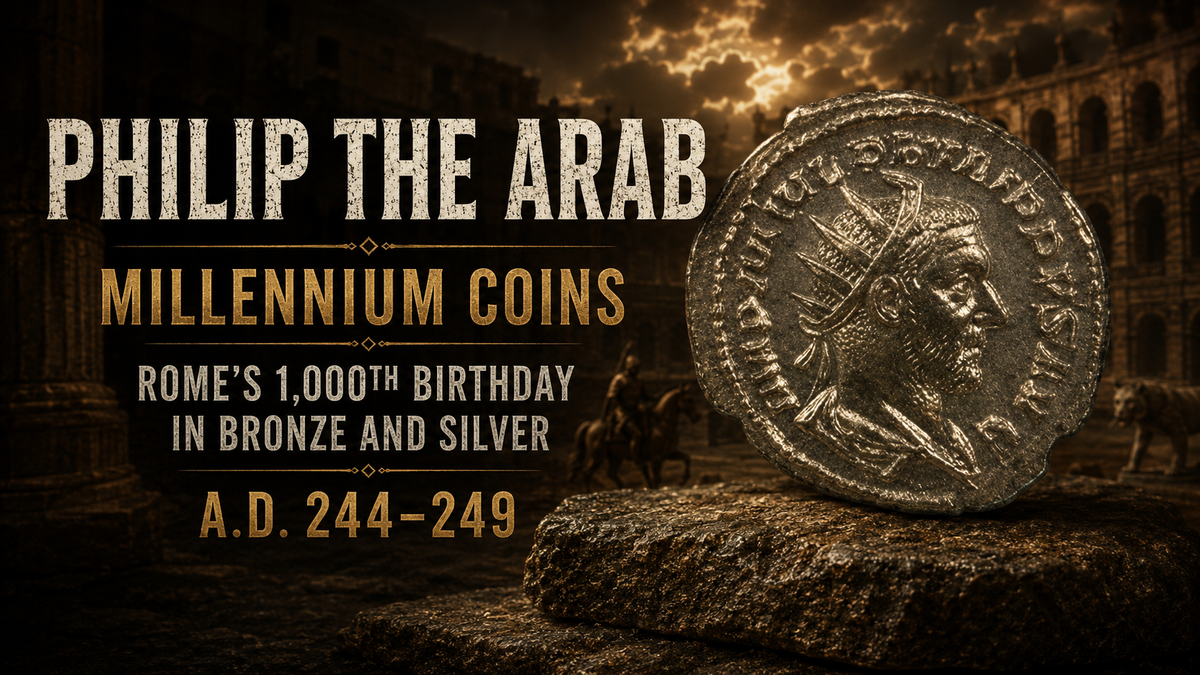
Philip the Arab: The Emperor Who Celebrated Rome's 1,000th Birthday
AD 244 to 249, millennium emperor, the famous animal coins.
Few Roman emperors are as historically fascinating, or as visually distinctive in their coinage, as Philip the Arab.
Ruling from AD 244 to 249 during the Crisis of the Third Century, Philip presided over one of the most symbolic moments in Roman history: the celebration of Rome's 1,000th anniversary.
His reign combined military conflict, political instability, economic strain, and massive imperial spectacle, and his coins include some of the most collectible and historically important issues of the entire 3rd century.
The Rise and Fall of Philip the Arab
Philip was born around AD 204 in the Roman province of Arabia, likely near modern-day Shahba in the southern Levant. His rise reflects how diverse the Roman Empire had become by the 3rd century. Emperors no longer came only from Italy or the old aristocracy; powerful military leaders from across the provinces could reach the imperial throne. Philip rose rapidly under Gordian III, eventually becoming praetorian prefect after the death of Timesitheus, Gordian's powerful commander. During a Persian campaign, Gordian III died under unclear circumstances in AD 244, and Philip was proclaimed emperor by the army.
One of his first challenges was ending Rome's war with the Sasanian Persians under Shapur I. Philip negotiated peace quickly, likely paying a substantial indemnity, criticized by some Roman writers, viewed by others as a practical move during a dangerous moment. The agreement allowed him to return west and consolidate power. His reign then saw the great millennium celebrations of AD 248, but also mounting frontier pressure, internal revolts, and the rise of Decius as a rival. In AD 249, Philip was defeated and killed near Verona.
Philip celebrated Rome's eternal greatness with massive games and spectacular coinage even as the instability that would kill him was already building. His coins capture that contradiction perfectly.

The Millennium Celebrations and the Animal Coins
In AD 248, Philip celebrated the Ludi Saeculares, the games marking Rome's 1,000th anniversary. Ancient sources describe gladiatorial contests, theatrical performances, religious ceremonies, and exotic animals from across the empire paraded before the Roman public. These celebrations produced some of the most famous commemorative coinage ever struck in Rome.
- Lion, bold, powerful imagery from the games
- Elephant, one of the most visually striking reverses
- Hippopotamus, rare and highly collectible
- Stag, beautifully engraved on high-grade examples
- Antelope, an elegant design from the African frontier provinces
- Goat, a classic part of the anniversary series
The wife who stood beside Philip through the millennium celebrations, Otacilia Severa, appears on her own silver antoniniani struck during the same anniversary years, a natural companion to the emperor's own coinage and to the animal series.

The Full Coinage of Philip the Arab
Philip's coinage is among the most diverse and collectible of the 3rd century.
- Silver antoninianus, the primary silver denomination, often well struck with historically important reverses
- Bronze sestertius, large flans, bold portraits, and detailed reverses
- Provincial tetradrachms, extensive eastern coinage from Antioch, Alexandria, and cities of the Levant and Arabia, with Greek legends and local deities
- Gold aureus, visually impressive and historically important mid-3rd century gold
How to Collect Philip the Arab
Start here. Common antoniniani and provincial tetradrachms, an affordable entry into one of the most historically rich collecting areas of the 3rd century.
Go deeper. Complete the animal reverse set across sestertii and antoniniani, or explore eastern mint issues and provincial silver. A family group with Otacilia Severa and his son Philip II turns a single coin into a portrait of the dynasty that presided over Rome's thousandth year.
Philip the Arab presided over one of the most symbolic moments in all of Roman history: the empire's thousandth birthday, celebrated with games, spectacle, and some of the most distinctive commemorative coinage Rome ever struck. That his reign fell in the middle of the Crisis of the Third Century, a period of near-constant instability, only sharpens the contradiction his coins preserve. An emperor from the province of Arabia, celebrating a thousand years of Rome, while the empire strained around him. For collectors, few 3rd century emperors offer a richer combination of history, imagery, and accessibility.
Hold what the greats held.
Browse Coins of Philip the Arab at Kinzer Coins
Authentic mid-3rd century Roman coins, millennium commemoratives, animal reverses, and provincial tetradrachms, NGC-certified where available, with 30-day returns.
Browse Roman Coins