

Emperor Tacitus Coins: Collecting Rome’s Six-Month Emperor
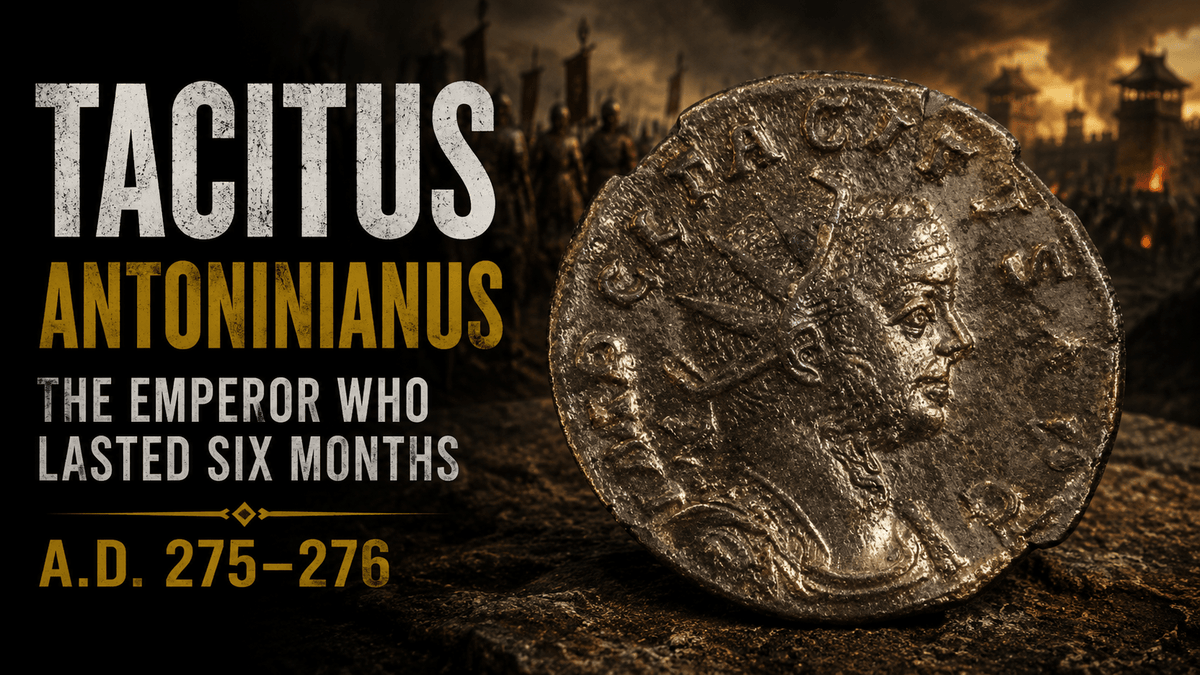
Emperor Tacitus: Collecting Rome's Six-Month Emperor
AD 275 to 276, a brief reign between Aurelian and Probus.
Tacitus ruled for only months, but his accession and death preserve some of the most disputed stories of the later third century.
Coming to power after Aurelian's assassination, Tacitus was later portrayed as a senatorial choice who briefly restored civilian prestige. Modern reconstructions are more cautious: the army appears to have played the decisive role, with the Senate confirming or participating in the settlement.
His coins belong to the recovery phase of the Crisis of the Third Century and offer collectors a compact series of radiate issues from a short, unsettled reign.
How Did Tacitus Become Emperor?
Marcus Claudius Tacitus was probably born around AD 200, although his origins and early career are poorly documented. Later literary sources describe an unusually long interregnum after Aurelian's assassination and portray the Senate as choosing Tacitus. That constitutional-looking story is disputed. The stronger modern reconstruction is that the army selected or accepted Tacitus and the Senate then confirmed him, rather than independently reclaiming the right to appoint emperors.
Ancient writers also connected him with the historian Publius Cornelius Tacitus, but that claimed ancestry is not considered reliable. Soon after his accession, Tacitus and his forces confronted Gothic and other groups who had entered Asia Minor. The campaign produced Roman successes and victory titles, but his reign was too short to establish a durable political settlement.
Tacitus died in Asia Minor in AD 276. The sources do not agree on how: some traditions describe illness, while others report assassination connected with military unrest. His relative Florian then claimed the throne before Probus emerged victorious.

What Coins Did Emperor Tacitus Issue?
The traditional silver denarius was no longer the principal imperial denomination. Tacitus's most familiar coins are radiate pieces conventionally called antoniniani, struck in a copper-based alloy and often given a thin silvered surface. Despite his short reign, several imperial mints produced a varied coinage with multiple bust types, officina marks, and reverse legends.
- Victory and imperial virtues, Victory, Providentia, Clementia, Pax, and related types belonging to the broader language of legitimacy and successful rule, not a single coordinated "restoration" program
- Military and divine types, Mars, Sol, Jupiter, military imagery, and protective deities, reflecting the religious and military vocabulary common to late-third-century coinage
- Silvered surfaces, some Tacitus radiates retain substantial original silvering, adding visual appeal and value, especially with a strong portrait and clear reverse
- Tacitus and Florian, a Tacitus and Florian pair makes a focused short-reign set linking Aurelian's death to the rise of Probus, with Florian's even briefer reign making the pairing especially useful
Tacitus coins are less plentiful than those of longer-ruling emperors such as Aurelian or Probus, but many standard radiates remain obtainable. Price and scarcity vary sharply by mint, reverse, bust type, officina, condition, and surviving silvering. For a first example, prioritize a clear portrait, readable legends, identifiable mint or officina marks when present, and sound surfaces rather than assuming every Tacitus coin is inherently rare.
Major Mints of Tacitus
Tacitus's short reign was represented at multiple imperial mints. Mint attribution matters because portrait style, reverse combinations, officina systems, and scarcity can vary significantly across the series.
- Rome, a major source of Tacitus radiates with numerous reverse and officina combinations
- Siscia and Serdica, important Balkan production with distinctive mint and officina patterns
- Ticinum, northern Italian issues useful for studying mint style and officina organization
- Cyzicus and Antioch, eastern production with their own portrait styles, legends, and mintmark combinations
Why Collect Tacitus Coins?
Tacitus sits between two much better-known emperors, Aurelian and Probus, and his coins help complete that rapid succession. The series rewards collectors who enjoy short reigns, mint attribution, officina marks, surviving silvering, and the political uncertainty of the late third century. The history is compelling precisely because the evidence is imperfect: his supposed senatorial restoration, ancestry, and manner of death all require more caution than older narratives often suggest.
For collectors of the Crisis of the Third Century, Tacitus is one of the emperors who makes a chronological run feel complete. His radiates are the tangible record of a six-month reign that tried, and failed, to bring stability to an empire lurching between soldier-emperors, and they connect directly to the recovery that Probus and then Diocletian would eventually secure.
Hold what the greats held.
Browse Coins of Tacitus at Kinzer Coins
Authentic late Roman radiates from one of the shortest imperial reigns of the third century, NGC-certified where available, guaranteed authentic, with 30-day returns.
Browse Roman Coins