

Magnentius Coins: Chi-Rho Bronzes & the Civil War of AD 350–353
Collecting the Coins of Magnentius
AD 350 to 353, the usurper who nearly took the Roman Empire, and the Chi-Rho bronze.
Magnentius was not born into imperial power. He seized it, and came closer than almost any usurper to permanently replacing the Constantinian dynasty.
A military commander of barbarian descent who rose through the ranks under Constans, Magnentius was proclaimed emperor at a banquet in Gaul in January AD 350. Within weeks Constans was dead. Within months, Magnentius controlled Gaul, Britain, Hispania, and parts of Italy.
The eastern emperor Constantius II refused to recognize him, and the conflict escalated into one of the bloodiest civil wars of the 4th century. Magnentius fought brilliantly for three years before committing suicide at Lyon in AD 353 after his final defeat. His coins, large, bold, and bearing some of the most striking Christian imagery ever struck on Roman bronze, are among the most historically dramatic collectibles of Late Antiquity.
The Rise and Fall of Magnentius
Magnentius rose through the elite Jovian and Herculian guard units under a deeply unpopular Constans. The conspiracy that made him emperor was bold and fast: purple robes thrown over his shoulders at a military banquet, Constans hunted down and killed near the Pyrenees, and the western provinces falling into line with remarkable speed. For a brief moment it looked like he might actually win. He gained recognition across most of the western empire and even made diplomatic overtures to Constantius II, all rejected.
The decisive moment came at the Battle of Mursa Major in AD 351, described by ancient sources as one of the bloodiest battles in Roman history, with catastrophic casualties on both sides. Magnentius lost. He retreated into Gaul, held on for two more years of grinding resistance, and finally ended his own life at Lyon after the Battle of Mons Seleucus in AD 353. The Constantinian dynasty survived. But it had come remarkably close to ending entirely.
Holding a coin of Magnentius is holding a relic from a moment when the future of the Roman Empire hung in the balance.

The Coinage of Magnentius
Magnentius issued some of the most visually impressive bronze coinage of Late Antiquity, large centenionales and double-centenionales with bold portraits and dramatic reverse designs. His portraits are immediately recognizable: broad-faced, heavily armored, stern and militaristic, executed in the confident style of a man who needed to project absolute legitimacy.
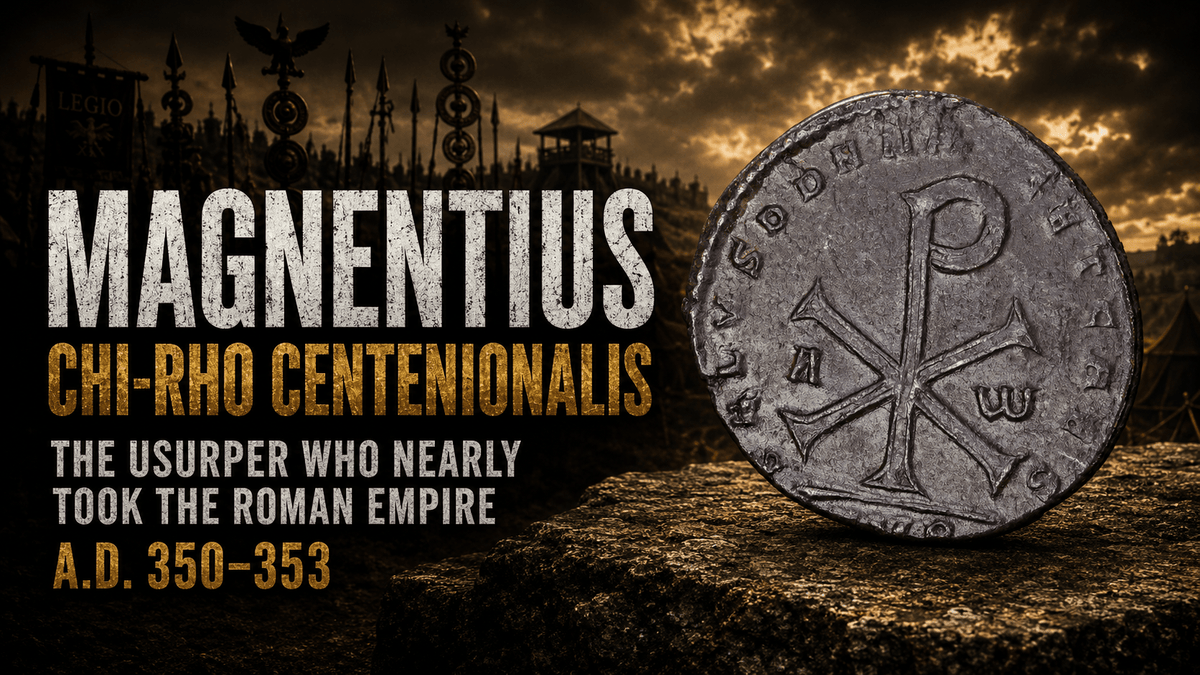
The most famous Magnentius coins bear the reverse legend SALVS DD NN AVG ET CAES, displaying the Chi-Rho monogram of Christ flanked by the Greek letters Alpha and Omega. It was one of the boldest uses of Christian symbolism on Roman coinage of the entire 4th century. The design served multiple political purposes simultaneously: appealing to Christian populations across the western provinces, connecting Magnentius to Constantine's legacy without being a member of his family, and invoking divine legitimacy during a civil war against a legitimately crowned emperor. Whether Magnentius himself was Christian or simply a skilled political propagandist remains debated. Either way, the Chi-Rho bronze is now one of the most iconic and sought-after types in all of late Roman numismatics.
- Chi-Rho centenionalis, SALVS DD NN AVG ET CAES, a large bronze with the Chi-Rho flanked by Alpha and Omega, the defining Magnentius type and among the most iconic Christian-themed coins of the 4th century
- Double-centenionalis, among the largest and heaviest bronzes of the mid-4th century, substantially broader than typical Constantinian issues, visually extraordinary display pieces
- Victoriae DD NN, two Victories holding a shield inscribed VOT V MVLT X, projecting confidence and dynastic continuity despite ruling without Constantinian blood
- Military types, fallen horseman variants, emperor advancing, and military standards, bold martial imagery reinforcing his identity as a soldier-emperor
Mints of Magnentius
Magnentius struck coins exclusively at western imperial mints, the geographic footprint of his rebellion and his base of support against Constantius II in the east. The western mint concentration gives his coinage a distinct character and makes mint collecting particularly rewarding.
- Trier, Lyon, and Arles, the core Gallic mints at the heart of his power base
- Rome, Aquileia, and Siscia, the Italian and Balkan frontier mints marking the eastern edge of his control
Why Collect Magnentius
Start here. Chi-Rho centenionalis, the most sought-after Magnentius type and one of the most historically distinctive late Roman bronzes available at accessible prices. Full legend, centered strike, and bold portrait detail are the key quality markers.
Go deeper. Build a usurper set pairing Magnentius with Decentius, his Caesar and brother, or place him in a broader Constantinian dynasty collection as the man who nearly ended it. The most natural pairing is with his great rival, Constantius II, the legitimate emperor who defeated him at Mursa Major and preserved Constantine's dynasty.

Magnentius coins are large, bold, historically dramatic, and still relatively affordable, an unusual combination in late Roman numismatics. The Chi-Rho reverse alone is worth owning: a barbarian-born usurper putting the symbol of Christ on some of the biggest bronze coins Rome had struck in decades, fighting a civil war for control of an empire built on Constantine's Christian legacy. His coins are propaganda, theology, and military ambition pressed into metal. Few late Roman issues tell a richer story for the price.
Hold what the greats held.
Browse Coins of Magnentius at Kinzer Coins
Authentic late Roman bronze from the usurper who nearly toppled the Constantinian dynasty, NGC-certified where available, guaranteed authentic, with 30-day returns.
Browse Roman Coins